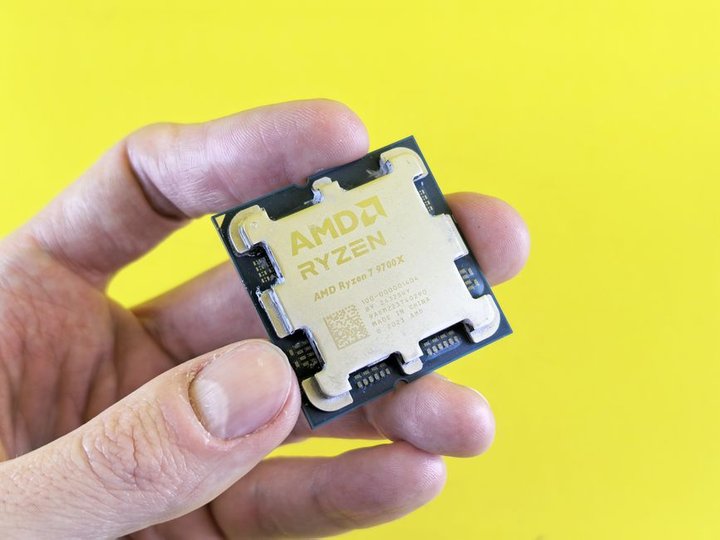
AMD’s Zen 6 CPU family represents a substantial evolution from Zen 5, with extensive reworking of core components that rivals the changes seen between Zen 1 and Zen 2, according to analysis from Chips and Cheese.
One of the most notable improvements is in branch prediction. Zen 6 reduces the latency cost of branch mispredicts to 3–3.5 nanoseconds compared to Zen 5’s 3.5–4 ns. The core also improves its ability to handle two branches per cycle within the L1 instruction cache, focusing on speed rather than capacity expansion. Zen 6’s Branch Predictor Unit maintains accuracy similar to Zen 5 while operating faster.
In the execution engine, Zen 6 brings back Zen 4’s NOP pairing behavior, retiring up to 16 NOPs per cycle. It sustains 5.96 64-bit adds per cycle versus Zen 5’s 5.25, despite using the same six ALUs. However, AMD reduced integer multiply units from three to two, with PDEP and PEXT throughput also declining from three to two instructions per cycle. According to AMD, Zen 5’s third multiply unit did not justify its area cost.
Vector performance sees mixed changes. Floating-point units remain unchanged at two 512-bit operations per cycle, but VNNI units double from two to four, improving quantized inference and video codec performance. Zen 6 increases 256-bit vector loads to four per cycle while maintaining 512-bit loads at two per cycle, both reaching 128 bytes per cycle total bandwidth.
The Zen 6 family introduces architectural divergence between Zen 6 and Zen 6c variants. Both use different core counts—12-core and 32-core CCDs respectively—but provide 4 MB of L3 cache per core. Zen 6 appears tuned for high frequency, while Zen 6c prioritizes capacity with larger out-of-order structures: a reorder buffer growing from 576 to 640 entries, integer register file from 288 to 352, vector scheduler from 138 to 180, and load queue from 280 to 330.
L3 latency increased from approximately 47 cycles on Zen 5 to 55 cycles on Zen 6 and 66 cycles on Zen 6c, though in nanoseconds Zen 6’s higher clock masks most of this increase at 10.7 ns versus Zen 5’s 10.3 ns. Zen 6 also fixes Zen 5’s L2 bandwidth limitations, now reliably delivering 64 bytes per cycle compared to Zen 5’s roughly 42 bytes per cycle.
In SPEC CPU 2026 benchmarks, the EPYC 9686F leads the EPYC 9996 by approximately 18% in both integer and floating-point suites. The 9686F scores 6.20 versus 5.25 in integer rate and 10.6 versus 8.99 in floating point, showing substantial gains in memory-heavy workloads.
Key facts
- Zen 6 reduces branch mispredict latency to 3–3.5 ns from Zen 5’s 3.5–4 ns
- Integer multiply units reduced from three to two, with PDEP/PEXT throughput declining from three to two instructions per cycle
- VNNI units doubled from two to four, improving quantized inference and video codec performance
- L2 bandwidth improved to 64 bytes per cycle from Zen 5’s approximately 42 bytes per cycle
- Zen 6c features larger out-of-order structures than Zen 6, tuned for memory latency tolerance versus high-frequency performance
- EPYC 9686F leads EPYC 9996 by approximately 18% in SPEC CPU 2026 benchmarks