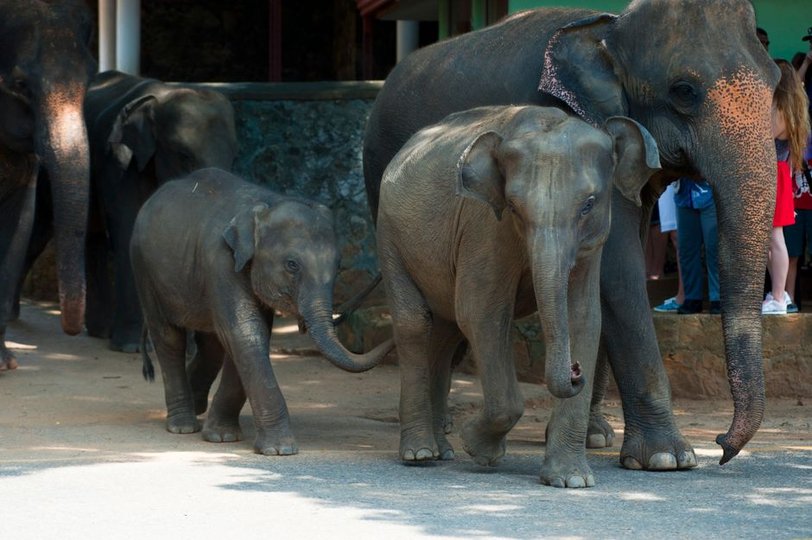
University of California San Diego scientists have documented a troubling shift in Asian elephant social structures, according to a study published in Science on November 12. Researchers from the School of Biological Sciences analyzed social dynamics among more than 440 wild female Asian elephants over 12 years at Udawalawe National Park in Sri Lanka.

The study, led by Postdoctoral Researcher Anastasia Madsen in the laboratory of Associate Professor Shermin de Silva, found that population declines triggered a critical transition in elephant communities. As the number of elephants decreased due to deaths, emigrations, and fewer incoming individuals, the social structure shifted from large, densely connected groups to smaller, more isolated ones.
“We found that gradual accumulation of losses from turnover preceded sudden change in the social networks among females in a wild population of Asian elephants,” the researchers explained. According to Madsen, “With fewer individuals in the population, those who are left will naturally have fewer relationships. However, the remaining elephants are also changing their relationships with each other.”
The researchers identified what they describe as a social structure tipping point. Beyond this threshold, the remaining elephants not only have fewer potential relationships but are actively restructuring their social bonds in ways that may prove difficult to reverse.
This transformation poses significant risks for the animals. Asian elephants rely on social groups and connections to forage, acquire information, and raise young. De Silva noted the parallel to human social isolation, emphasizing that “social connectivity is very much a matter of sharing space and building relationships throughout our lives” and that “resilient communities” require the ability to replace lost relationships over time.
Multiple factors contribute to the population decline at Udawalawe National Park, which spans 119 square miles. These include deaths from poaching and human-wildlife conflict, disruptions in habitat connectivity, and reduced food availability as ecological conditions change across the park and surrounding areas.
Madsen cautioned that the new social fracturing observed may be difficult to reverse. “In general, we need to be more aware of these types of tipping points where we see sudden shifts after changes have been slowly building up,” she said. “Once we move past the tipping point, it’s much harder to go back to previous states.”
The researchers suggest that monitoring social patterns in elephant populations could serve as an early warning system for conservation efforts, particularly as human expansion continues into historically occupied elephant habitat.
Key facts
- UC San Diego researchers tracked over 440 wild female Asian elephants for 12 years in Sri Lanka
- The study identified a social tipping point where elephant populations shifted from large, connected communities to smaller, isolated groups
- Population decline resulted from deaths, emigrations, and fewer incoming individuals to the Udawalawe National Park population
- Elephants depend on social networks to forage, acquire information, and raise young
- Researchers warn that fractured social structures may be difficult to reverse once the tipping point is crossed