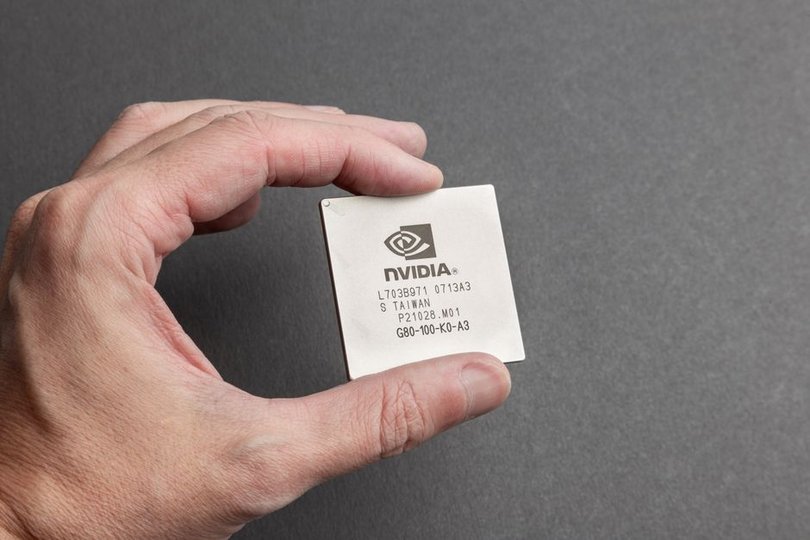
Nvidia built its dominance in AI accelerators under Jensen Huang, who foresaw the technology’s potential and invested in chips years ahead of competitors. But as Huang has stepped down and CFO Colette Kress takes over, the company confronts a converging set of challenges that threaten its market position.
According to Silicon Analysis, Nvidia controls 80 percent of the AI accelerator market. Yet competitors are steadily gaining ground. AMD has grown its share from 2 percent in 2022 to between 7 and 10 percent by 2026. Meanwhile, major cloud providers—Google, Amazon, and Microsoft—are developing specialized chips to reduce costs and independence from Nvidia. Startups like Cerebras offer alternatives for specific use cases, and AMD acquired Taalas, a company focused on efficient chip design for AI workloads.
The shift toward AI agents and inference workloads particularly challenges Nvidia. According to Patrick Moorhead, chief analyst at MoorInStrat, inference is an area where cloud hyperscalers and startups have greater competitive advantages. Nvidia did acquire Groq, a startup making specialized inference chips, in December 2025. The rising importance of general-purpose CPUs—a market where Nvidia barely competes—adds another pressure point.
In China, Nvidia’s position has deteriorated significantly. The company accounts for only 8 percent of Nvidia’s revenue in 2026, down from 20 percent in 2024, as US export restrictions limit sales of advanced chips. Chinese firms like Huawei have developed supercomputers that coordinate many chips for AI training, and Chinese AI companies report training models entirely on Huawei hardware. If Chinese open-source models gain international traction, demand for Chinese chips could expand globally.
Another vulnerability emerges from AI’s own capabilities. Moorhead notes that AI models can now rapidly rewrite code to run on competitor hardware, potentially eroding Nvidia’s CUDA software advantage—long viewed as a moat keeping developers locked to Nvidia silicon. Wafer, a startup using AI to port models to AMD hardware, claims it can achieve 80 percent efficiency within hours of a new model’s release, with minimal human code review.
Dan Hutchinson, a veteran chip analyst, compares Nvidia’s situation to Intel’s 2019 transition, when engineering-focused leadership gave way to a sales-focused CFO, eventually followed by bureaucratic bloat and declining innovation. Huang’s departure and Kress’s appointment echo that shift, raising questions about whether Nvidia can maintain technical leadership as it faces both external competition and internal organizational change.
Key facts
- Nvidia controls 80% of AI accelerator market but competitors are gaining: AMD grew from 2% (2022) to 7-10% (2026)
- Google, Amazon, and Microsoft are developing their own AI chips to reduce costs and dependence on Nvidia
- Nvidia’s China revenue dropped from 20% of total in 2024 to 8% in 2026 due to US export restrictions
- AI models can now automatically rewrite code for competitor hardware, potentially weakening Nvidia’s CUDA software moat
- Startups like Cerebras and Wafer offer specialized alternatives; Nvidia acquired Groq in December 2025