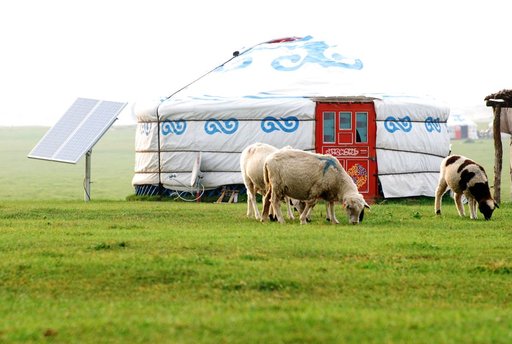
Two new research papers from Cornell University examine the growing practice of grazing sheep around solar arrays, exploring both ecological and economic benefits.
According to research led by postdoctoral associate Leana Zoller, when two sheep per hectare graze around solar arrays, the abundance of wild bees, honey bees, and lady beetles increased by 38% compared to mowed control plots. The increase was driven primarily by an 83% increase in honey bees alone, according to findings published Oct. 7 in Environmental Research Letters.
Zoller and a team of entomologists, ecologists, and animal and plant scientists tested various stocking rates at Cornell’s Cascadilla Community Solar Farm in Dryden, New York, over three years. At four sheep per hectare, beneficial insect abundance matched the mowed control site while vegetation management improved. At eight sheep per hectare, vegetation management was maximized and sheep flock health remained high, but honey bee abundance dropped by 45%.
Steve Grodsky, senior author and assistant professor of natural resources, noted that researchers focused on stocking rates as “a concrete number that sheep farmers understand and work with every day” to make findings actionable for farmers and solar developers.
A second Cornell research team from the SC Johnson College of Business developed a decision-support tool to help farmers optimize solar grazing operations. The spreadsheet-based model, described in a paper published Sept. 28 in Manufacturing & Service Operations Management, helps sheep farmers make better decisions about procurement, sales, flock size, and costs based on factors like anticipated revenues and expected vegetation at solar sites. United Agrivoltaics has already incorporated the tool into its onboarding process.
Researcher Vincent Slaugh noted that solar grazing contracts provide steady income and animal feed, potentially enabling growth in the U.S. sheep industry. Currently, about half of all lamb and mutton consumed in the U.S. is imported, primarily from New Zealand and Australia. According to Nikola Kochendoerfer, a sheep farmer operating 700 ewes on solar installations in New York and Vermont, the economic model is already driving expansion: “With solar grazing, you get paid to graze as opposed to having to pay to graze.”
Funding came from the Cornell Atkinson Center for Sustainability, the National Institute for Food and Agriculture, and the National Science Foundation.
Key facts
- Sheep grazing at two per hectare increased wild bee, honey bee, and lady beetle populations by 38% compared to mowed control plots
- Honey bees alone increased by 83% at the two sheep per hectare density
- At eight sheep per hectare, honey bee abundance dropped 45% despite maximized vegetation management
- About 50% of lamb and mutton consumed in the U.S. is imported, primarily from New Zealand and Australia
- United Agrivoltaics has incorporated the Cornell decision-support tool into its onboarding process